Online Metronome Scale Practice: Master Speed Without Rushing
Are you tired of your scales sounding uneven? Do you find yourself rushing through difficult passages, only to lose control and make mistakes? These are common frustrations for musicians on any instrument. But what if the secret to playing faster wasn't about pushing for speed, but about building a rock-solid foundation of precision?
This is where a metronome becomes your most valuable practice partner. It doesn't just keep time; it transforms your approach to learning. Use a metronome for scale practice. It builds clean technique. It develops an unshakeable internal rhythm. Best of all, it leads to effortless speed. This guide will show you exactly how.
We'll break down the most effective methods for practicing scales with a metronome, from setting your first tempo to mastering advanced techniques. And the best part? You can start right now with our powerful and completely free online metronome, accessible on any device.

How to Practice Scales with a Metronome Effectively
Simply turning on a metronome isn't enough. The magic happens when you use it with a clear, methodical plan. An effective metronome practice routine is built on three core pillars: starting slow, understanding rhythm, and increasing speed gradually. This approach ensures you build accuracy first, which is the true foundation of speed.
Setting Your Initial BPM with Online Metronome: Start Slow, Build Strong
The most common mistake musicians make is setting the tempo too high. We're eager to play fast, but this often reinforces bad habits and unevenness. The golden rule of metronome practice is to start at a tempo where you can play the scale perfectly and without any physical tension.
For most people, a good starting point is between 50 and 70 BPM (Beats Per Minute), playing one note per click. At this speed, you have enough mental space to focus on every detail: clean fingerings, consistent tone, and relaxed posture. Your goal here isn't a speed challenge. It's flawless execution.
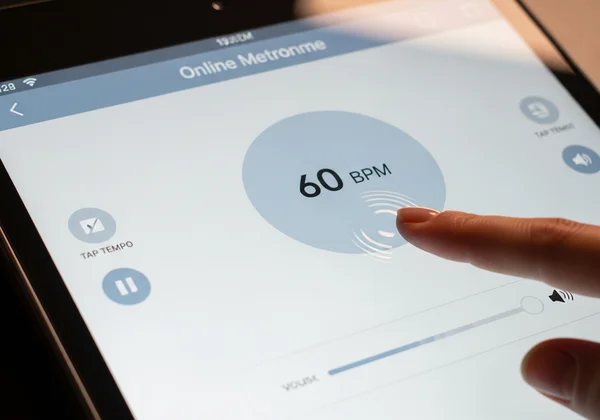
Ready to find your starting tempo? Open the metronome tool, set it to 60 BPM, and play a simple one-octave scale. If you can play it perfectly five times in a row, you've found a great starting point.
The Power of Subdivision: Mastering Rhythmic Precision
Once you are comfortable playing one note per click, the next step is subdivision. Subdivision means playing multiple notes for each metronome click. This technique is crucial for developing a deep sense of rhythmic accuracy and making your playing feel smooth and connected.
Here’s how to approach it:
- Eighth Notes: Play two notes for every click. The first note lands with the click, and the second falls exactly in between clicks.
- Triplets: Play three evenly spaced notes for every click. This is common in blues, jazz, and classical music.
- Sixteenth Notes: Play four evenly spaced notes for every click. This is essential for faster passages in rock, pop, and classical styles.
Practice subdivisions slowly. This trains your brain to feel the space between beats. When you speed up, every note lands perfectly. Say goodbye to sloppy rushing.
Graduated Practice: The Step-by-Step Approach
Now that you have your starting tempo and understand subdivision, you can begin to build speed systematically. This isn't about jumping from 60 BPM to 120 BPM in one day. It's about making small, consistent gains that your brain and muscles can absorb.
Here’s how to build speed systematically:
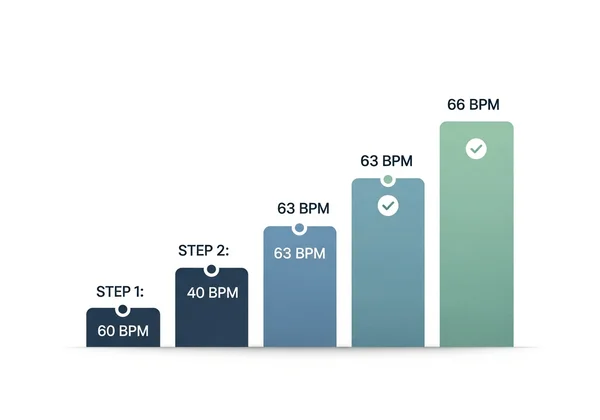
- Find Your "Perfect" Tempo: Set the metronome to a speed where you can play your scale flawlessly with a chosen subdivision (e.g., eighth notes).
- Achieve Consistency: Play the scale up and down perfectly 3-5 times in a row without stopping. If you make a mistake, start the count over.
- Increase Speed Slightly: Once you've proven your consistency, increase the tempo by just 2 to 5 BPM.
- Repeat the Process: At the new, slightly faster tempo, repeat step 2. Master the scale at this speed before moving up again.
- Know When to Stop: If you start making repeated mistakes or feel tension, you've gone too far. Lower the tempo back to a speed you can control and solidify your technique there.
This process builds real speed. It starts with accuracy, not just cranking up the dial.
Instrument-Specific Tips for Metronome Scale Practice
While the principles of metronome practice are universal, every instrument presents unique challenges. Applying these ideas with your instrument in mind will help you overcome specific technical hurdles and see even faster progress.
Guitar Scales Metronome Online: Picking & Legato Precision
For guitarists, the biggest challenge is often synchronizing the fretting and picking hands. The metronome is the ultimate tool for tightening this connection. When you use a guitar scales metronome online, you get instant, unbiased feedback on your timing.
- Alternate Picking: Set the metronome to a slow tempo and practice scales with strict alternate picking (down-up-down-up). Focus on making sure the pick strike and the fretted note sound at the exact same moment as the click.
- Legato Technique: Use the metronome to ensure your hammer-ons and pull-offs are rhythmically accurate. It’s easy for legato phrases to become sloppy, but practicing them to a click will give them rhythmic definition and power. Our online BPM tool is perfect for this focused work.
Piano Scale Speed BPM: Fingerings & Evenness
Pianists strive for scales that sound like a string of perfectly matched pearls—each note even in tone and timing. Improving your piano scale speed BPM depends entirely on this evenness, which a metronome helps to cultivate.
- Consistent Fingerings: The metronome forces you to be honest about your fingerings. At a slow tempo, you can focus on smooth thumb-tucks and consistent hand positioning, which are essential for speed.
- Even Dynamics: Record yourself playing a scale with the metronome. Do some notes stick out louder than others? Use the steady click to practice playing every note with the same volume and attack. This is the key to a professional, polished sound.
Advanced Metronome Techniques for Scale Mastery
Once you've mastered the fundamentals, you can use the metronome in more creative ways to challenge your internal clock and push your skills to the next level. These advanced techniques are designed to build deep rhythmic confidence.
Implementing Speed Bursts: Pushing Your Limits Safely
Speed bursts are a powerful technique for getting your hands and mind accustomed to faster tempos without the pressure of sustaining them. It’s like interval training for your fingers.
Here’s how it works:
- Set your metronome to a comfortable practice tempo (e.g., 80 BPM).
- Play the first four notes of your scale at a much faster rhythm, such as sixteenth notes at 120 BPM.
- Pause, breathe, and reset.
- Repeat this "burst" on the next four notes of the scale.
This method allows you to experience the physical feeling of playing fast in a controlled environment. It builds neural pathways and muscle memory for speed. You can do this without developing the bad habits that come from long, tense, rushed playing.
Silent Practice for Internalizing Your Inner Metronome
This is the ultimate test of your rhythmic stability. The goal is to develop an "inner metronome" that is so strong you don't need an external click.
- Set the metronome to a slow or medium tempo.
- Play for one full measure (e.g., four beats) with the click.
- Mute the metronome (or use a practice app with this feature) and continue playing for the next measure, keeping the time silently in your head.
- Turn the click back on for the third measure. Did you land perfectly on the beat?
Practicing with silent gaps forces you to take full responsibility for the time. It moves the source of rhythm from the machine to your own body. This is the ultimate goal of all metronome work. You can easily do this by starting and stopping our simple metronome.

Your Journey to Flawless Scales Starts Now
The metronome isn't just a ticking box. It's a teacher, a coach, and a mirror that reflects your true sense of time. By embracing it as a fundamental part of your practice, you can transform your playing from hesitant and uneven to confident and precise.
Keep these in mind as you practice:
- Start slow for rock-solid accuracy.
- Nail subdivisions to own the space between beats.
- Bump up the tempo bit by bit.
Don't let another practice session go by without this essential tool. Your journey to mastering your instrument and achieving effortless speed is just one click away.
Open the free online metronome right now, set it to 60 BPM, and play your first perfect scale.
Frequently Asked Questions About Metronome Scale Practice
What is the ideal starting BPM for scale practice?
There is no single "ideal" BPM. The best starting tempo is one where you can play the scale perfectly. You should have no mistakes and no physical tension. For many musicians, this is between 50-70 BPM. Always prioritize accuracy over speed.
How can a metronome prevent me from rushing scales?
A metronome provides an objective, unwavering pulse that acts as an anchor for your playing. The metronome forces you to align with its steady click. This immediately reveals where you tend to speed up. It trains you to maintain a constant tempo.
Can I use the metronome for scales on any instrument?
Absolutely. The principles of rhythm, tempo, and timing are universal in music. Whether you play guitar, piano, violin, bass, flute, or even practice vocal scales, using a metronome will build precision and control. Our online tool works for any musician.
What are "speed bursts" in metronome scale practice?
Speed bursts are an advanced practice technique. You play a very short musical phrase (like 4 to 8 notes of a scale) at a fast, goal-oriented tempo, and then you pause. This is different from practicing the entire scale at high speed. It helps your mind and muscles adapt to faster movements in a controlled, low-pressure way.