Downbeat Accent on a Metronome
Why a steady click does not always fix the bar line
A plain click can keep you moving, but it does not always tell you where the measure begins. That is why many players can stay close to the beat and still lose track of beat one after a few bars.
This problem shows up in simple practice situations. A pianist repeats a left-hand pattern, a singer counts into a phrase, or a drummer loops one groove. The clicks stay even, yet the shape of the bar starts to blur.
That is where the accent setting helps. The stronger first click of each measure gives your ear a landmark inside the pulse. If you want to test that difference right away, the browser metronome lets you switch BPM, time signature, and downbeat accent on one page.
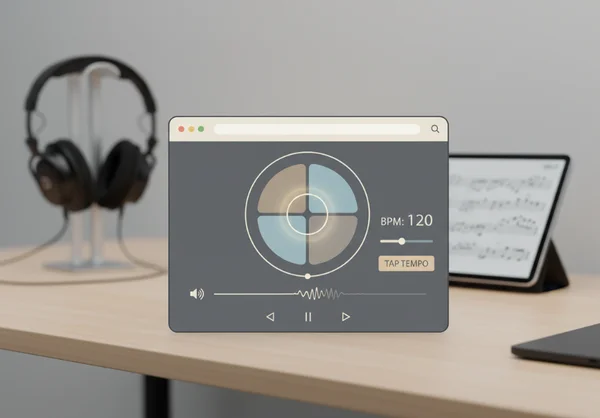
What the downbeat accent tells your ear
How time signatures shape the first beat
A downbeat accent makes more sense when you know what the meter is doing. The University of Puget Sound time-signature guide says the top number shows how many beats are grouped together. The bottom number shows which note value counts as the beat.
That matters because 3/4 and 4/4 are not just different counts. They organize the bar differently. In 3/4, your ear needs to hear a cycle of three beats before the pattern resets. In 4/4, the cycle lasts four beats. The accent does not change the meter, but it makes the start of each cycle easier to hear.
For beginners, that single change often removes a lot of guesswork. Instead of hearing four identical clicks in a row, you hear one stronger arrival followed by the lighter beats that belong to the same measure.
Why the strong beat helps measure awareness
The University of Puget Sound meter overview says bars can be duple, triple, or quadruple. In plain terms, that means the bar holds 2, 3, or 4 beats. That is the useful part of the accent setting: it reminds you that the click is not only a speed marker. It is also a repeating measure pattern.
Measure awareness matters most when the rhythm inside the bar is busy. Eighth notes, syncopation, and rests can pull your attention away from the first beat. A stronger downbeat pulls that attention back without forcing you to stop and recount every note.
This is especially helpful when you are learning a new section. The accent acts like a marker post. It tells you, “the bar starts here,” so your counting stays attached to the structure instead of floating over the clicks.
When to leave the accent on during practice
Early-stage practice in 3/4 and 4/4
Leave the accent on when you are still learning how the measure feels. A clear example is early work in 3/4 and 4/4, where the number of beats is simple but the physical feel is still new.
The same Puget Sound meter page notes that tempo can be expressed in beats per minute. It also says that 60 BPM equals one beat per second. That makes 60 BPM a useful teaching speed because each beat lasts long enough for you to hear the accented first beat, place the next beats around it, and notice whether you are rushing into the next bar.
In 3/4, try one short passage at 60 BPM and listen for a repeating pattern of strong-weak-weak. In 4/4, listen for strong-weak-medium-weak in a practical sense, even if the click only gives you one clearly accented beat. Those examples keep the accent tied to the bar instead of treating it like a random louder click.
If you are using the accent-ready practice tool, keep the speed low enough that you can count out loud without strain. The goal is not to survive the bar. The goal is to hear it clearly.
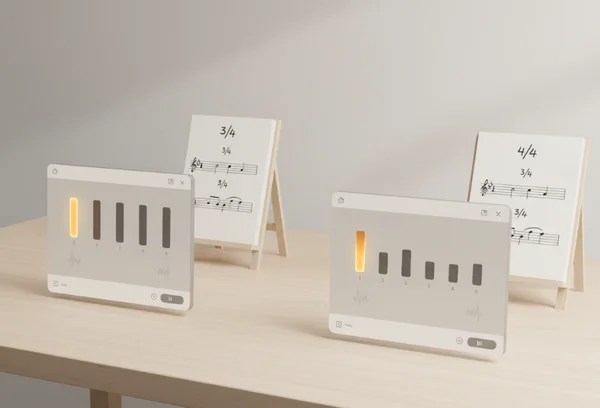
Count-ins, entrances, and repeated sections
The accent is also useful when the real challenge is starting together. Count-ins for ensemble practice, choir entrances, and repeated loops all benefit from a stronger beat one because everyone hears the same place to begin.
This matters even in solo work. If you stop after a mistake and restart from the top of a phrase, a visible and audible first beat helps you re-enter the passage without guessing where the bar begins. That is faster than rebuilding the pulse from scratch each time.
Repeated sections are another good use case. When a four-bar loop keeps cycling, the accent prevents the loop from becoming one long stream of identical clicks. It restores the frame around the phrase.
When to turn the downbeat accent off
Signs you are relying on the accent too much
The accent is a support, not the final goal. If you can only stay in time when the first beat is louder, you may be leaning on the setting more than you need.
One sign is that your bar line disappears as soon as the accent is removed. Another is that you always wait for the loud click instead of counting through the weaker beats. A third sign is that your phrasing becomes stiff because you are reacting to the accent instead of hearing the whole measure.
None of that means the setting is bad. It only means the setting has done its job and now needs to share the work with your own internal counting.
How to fade the support without losing time
The easiest fade is not technical. Do one pass with the accent on, then repeat the same passage with it off. If the bar still feels clear, keep going without the accent for another round. If it falls apart, turn the accent back on and slow the BPM a little.
You can also use the accent only at the start of a session. Let it establish the shape of the measure, then move to a plain click once your counting feels stable. This keeps the support where it helps most without letting it carry the whole exercise.
A simple rule works well here: use the accent to learn the bar, then use the plain click to prove you really know it. That is why the online beat reference is most useful when you treat the controls as practice stages, not permanent crutches.
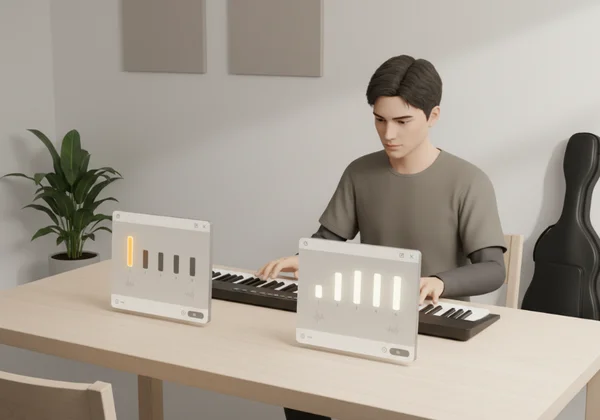
What to do next in your metronome session
Start with the time signature that matches your passage. Choose a BPM slow enough for clean counting. Then turn the downbeat accent on and ask one question: does this stronger first beat make the measure clearer, or am I already hearing the bar on my own?
If the bar still feels vague, keep the accent on for the next few passes. If the bar feels solid, switch it off and see whether your counting holds. That short test tells you more than leaving one setting unchanged for the whole session.
The best use of the accent is practical, not theoretical. Use it when it helps you hear the bar, then back away when your internal pulse is ready. For a quick setup before your next exercise, the rhythm practice page keeps BPM, meter, and accent controls in the same place.