Master Violin with Metronome: Essential Online Exercises
Unlock Your Violin's Potential: The Metronome as Your Practice Partner
Every violinist dreams of effortless precision. You want notes that sing with clarity and phrases that flow in perfect time. Yet, the path to that dream is often filled with frustrating challenges. Passages that sound clean when played slowly fall apart at tempo. Bow strokes feel uneven, and rhythm can feel more like a suggestion than a rule.
Are you struggling to maintain a steady tempo or clean rhythm in your violin playing? If so, you're not alone. The solution, however, is simpler and more powerful than you might think: consistent, intelligent practice with a metronome. This tool is not a critic designed to make you feel robotic; it is your most reliable practice partner, ready to build a rock-solid foundation for your musicality.
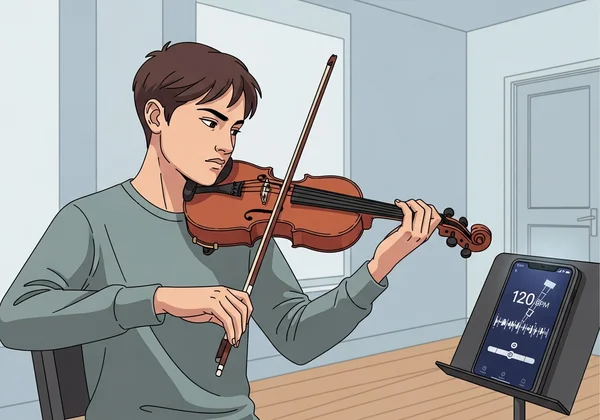
This guide will walk you through essential online exercises designed specifically for violinists. We’ll cover everything from fundamental bow control to advanced rhythmic techniques. To get started, all you need is your instrument and access to a reliable tool like our free metronome, which works perfectly on any device.
Precision Bow Control: Essential Metronome Exercises for Violin
The soul of the violin's sound comes from the bow. Without a steady and controlled bow arm, even the most accurate left-hand work will sound insecure. A metronome is the ultimate tool for developing that smooth, unwavering control that separates beginners from seasoned players. These exercises build the muscle memory needed for a beautiful, consistent tone.
Building a Steady Bow Arm with Slow BPM Drills
The secret to playing fast is practicing slowly. This exercise trains your arm to maintain constant speed and pressure from the frog to the tip of the bow. It’s a meditation in control that pays huge dividends.
- Set Your Tempo: Open the online tool and set the BPM (Beats Per Minute) to a very slow speed, such as 40 BPM.
- Choose an Open String: Start with the G or D string.
- Play Long Bows: On the first click, begin a down-bow. Your goal is to make the bow last for four full beats. The bow should touch the tip exactly on the first beat of the next measure.
- Repeat Up-Bow: Do the same with an up-bow, ensuring it also lasts precisely four beats.
- Listen Carefully: Your focus is on the sound. Is it even? Does it waver or get louder at the end? The goal is a perfectly smooth, consistent tone for the entire duration of the bow stroke. Once you master four beats, try extending it to eight.
Rhythmic String Crossings: Smooth Transitions with Metronome Cues
Clumsy or noisy string crossings can interrupt the flow of a musical line. The metronome provides the rhythmic framework to make these transitions seamless and silent. This exercise trains your right arm and wrist to prepare for each crossing just before the beat.
- Set a Moderate Tempo: Adjust your metronome to a comfortable 60 or 70 BPM.
- Choose Two Strings: Start with an easy pair, like the open D and A strings.
- Play Quarter Notes: Play one note per click, alternating between the strings: D, A, D, A.
- Focus on the Elbow: The key to a smooth string crossing is to move your elbow slightly to the new string level just before the note is played. The metronome click is your target. Your arm should already be in position when the click sounds.
- Vary the Rhythm: Once you feel comfortable, try patterns like two eighth notes on D followed by two eighth notes on A (D-D-A-A). Keep every note perfectly aligned with the beat and its subdivisions.
Sharpening Your Violin Rhythm & Tempo Training Techniques
With a more controlled bow arm, you can now focus on rhythmic accuracy. This is where your playing gains definition and drive. The metronome helps you internalize the pulse and master the subdivisions of the beat. This turns complex rhythms from a challenge into second nature.
Mastering Note Values: From Whole Notes to Tricky Sixteenths
Understanding note relationships is crucial. You need to know how whole, half, quarter, and sixteenth notes fit together. This scale exercise makes that relationship physical and audible.
- Choose a Scale: A simple one-octave G major or C major scale is perfect for this.
- Set the Metronome: Start at 60 BPM.
- The Rhythmic Pyramid:
- Whole Notes: Play each note of the scale, holding it for four clicks.
- Half Notes: Play each note for two clicks.
- Quarter Notes: Play one note per click.
- Eighth Notes: Play two notes per click.
- Sixteenth Notes: Play four notes per click.
- Listen and Align: Your job is to align the beginning of each note perfectly with the click or its subdivision. For eighth and sixteenth notes, ensure the notes between the clicks are perfectly even.
Conquering Challenging Passages with Gradual Tempo Increments
We’ve all been there: a fast passage in a piece feels impossible. We try to force it and end up with a mess of tense, inaccurate notes. The metronome offers a methodical, stress-free way to build speed without sacrificing accuracy.
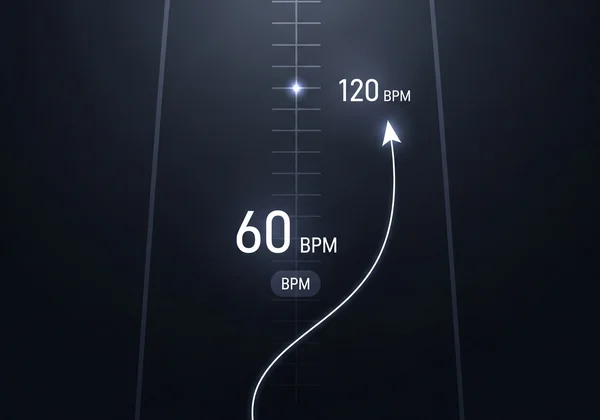
- Find Your "Perfect" Tempo: Identify the tricky passage. Using the Tap Tempo feature can help you find your current max speed. Now, lower the BPM until you find a tempo where you can play the passage flawlessly and without tension. This might be half the target speed, or even slower. This is your starting point.
- Repetition is Key: Play the passage correctly at this slow tempo three to five times in a row. This builds correct muscle memory.
- Make a Small Jump: Increase the tempo by just 2-4 BPM. This small increment is barely noticeable, allowing your brain and fingers to adapt easily.
- Repeat the Process: Play the passage correctly 3-5 times at the new, slightly faster tempo. Continue this process of small increases and successful repetitions.
- Know When to Stop: If you start making mistakes, you’ve increased the tempo too quickly. Go back down 2-4 BPM and solidify your playing there before moving on again. This patient approach guarantees you learn the passage accurately.
Elevating Expressive Playing: Vibrato and Advanced Metronome Use
A common fear is that metronome practice will lead to mechanical, lifeless playing. The opposite is true. By mastering rhythm, you free up your mind to focus on tone, phrasing, and emotion. A metronome can even be used to refine advanced techniques like vibrato and build a truly unshakeable internal sense of time.
Developing Consistent Vibrato Pulse: Synchronizing with the Beat
Vibrato brings warmth to your sound. But if it’s uncontrolled, it becomes distracting. You can use a metronome to develop a more consistent vibrato by gaining complete control over its speed.

- Start Slow: Set your metronome to 60 BPM.
- Play a Long Note: Choose a comfortable note on the D or A string.
- Sync the Pulse: Begin a slow, wide vibrato. Try to time the pulses of your vibrato with the metronome clicks, with one oscillation per beat.
- Subdivide the Vibrato: Once you feel stable, try pulsing the vibrato as eighth notes (two even oscillations per click). Then, try triplets (three even oscillations) and finally sixteenth notes (four even oscillations). This exercise isn't meant for performance, but it gives you incredible control over your vibrato speed.
Finding Your Inner Clock: Practicing Silent Metronome for Violinists
The goal? To build an unshakeable internal clock. Soon, you won’t need the metronome at all. This advanced exercise is a direct test of that internal pulse.
- Set a Simple Beat: Open our free tool and set it to a moderate tempo, like 80 BPM in 4/4 time.
- Play and Listen: Play a simple scale or passage for two full measures with the metronome.
- Go Silent: After two measures, stop the metronome but continue playing for the next two measures, keeping the tempo steady in your head.
- Check Your Accuracy: Start the metronome again on what should be the first beat of the fifth measure. Were you still in time? Did the click land exactly where you expected? This can be challenging at first, but it is one of the most effective ways to build true rhythmic independence.
Your Journey to Violin Mastery Starts with Metronome.wiki
Think of your metronome as a trusted coach—it doesn’t just keep time; it reveals gaps in your rhythm and guides you toward precision. By integrating these targeted violin exercises into your daily practice, you transform this simple tool into a powerful catalyst for growth.
- Start slow to build flawless bow control and muscle memory.
- Increase tempo gradually to conquer difficult passages without tension.
- Use the beat to master rhythm and even refine expressive techniques like vibrato.
Your journey to becoming a confident, precise, and expressive violinist is built one steady beat at a time. The exercises are here, and the next step is yours to take.
Visit our online metronome and set your first tempo. Your journey to violin mastery begins now.
Common Questions About Violin Metronome Practice
What is a good BPM for violin practice?
There is no single "best" BPM; it completely depends on your goal. For detailed technical work like improving intonation or bow control, starting very slowly (40-60 BPM) is highly effective. To build speed on a difficult passage, find the tempo where you can play it perfectly and increase it gradually. A flexible online metronome allows you to find the exact speed you need for any task.
How can a metronome improve my violin intonation?
While a metronome directly measures rhythm, it indirectly improves intonation. When your mind isn't struggling to keep time, it has more capacity to focus on listening carefully to the pitch of each note. Practicing scales and etudes slowly with a metronome provides the stability you need to hear and correct intonation issues more effectively.
Does practicing with a metronome make me sound robotic?
Many musicians worry about this, but here’s the truth: A metronome builds the rhythmic freedom needed for expressive playing. This strong foundation is what allows for true musical expression. Once you have an unshakable internal pulse, you can consciously choose to stretch a beat (rubato) for expressive effect. Without that foundation, playing often sounds rhythmically insecure, not musically free.
How often should I use a metronome for violin?
For the best results, use a metronome during a portion of every practice session. It is an invaluable tool for warm-ups, scales, and etudes. It is also essential for isolating and fixing rhythmically challenging spots in your pieces. Even 15-20 minutes of focused, daily practice with a metronome will yield remarkable improvements in your playing.