Mastering Metric Modulation: Advanced Techniques for Your Online Metronome
Have you ever listened to a piece of music and felt a sudden, exhilarating shift in tempo that felt both surprising and perfectly natural? Chances are, you were hearing metric modulation. For many musicians, executing these seamless tempo changes feels like a complex puzzle. This can often lead to awkward or jarring transitions in their performances.
The key to unlocking this advanced skill isn't just theory—it's precise, deliberate practice. This is where a powerful tool becomes your best ally. A reliable and customizable online metronome provides the framework you need to internalize these complex rhythmic ideas. It helps you translate them into fluid, professional-sounding music.
This guide will demystify metric modulation. We will break down the concept, explore practical exercises, and show you how to use a versatile online metronome to master these sophisticated tempo transitions. By the end, you'll understand how to incorporate these advanced rhythmic techniques into your playing.

Understanding Metric Modulation in Music
Before we can practice, we need to understand the fundamentals. Metric modulation is a powerful compositional device used to create smooth and logical transitions between different tempos. Instead of abruptly jumping from one speed to another, a rhythmic value from the first tempo becomes the new beat in the second. This creates a bridge between the two sections, making the change feel intentional and cohesive.
What is Metric Modulation and Why Musicians Use It
At its core, metric modulation is a change in tempo derived from a note value in the preceding tempo. For example, the triplet eighth note of a bar in 4/4 time at 120 BPM could become the new quarter note, establishing a new tempo. This technique allows composers and performers to alter the energy and feel of a piece without losing the underlying pulse.
Musicians use it for several reasons:
- To create dramatic effect: A sudden increase or decrease in speed can build tension or signal a shift in mood.
- To transition between sections: It provides a musically coherent way to move from a verse to a chorus or from one movement to another.
- To explore rhythmic complexity: Metric modulation is a hallmark of advanced composition, found in genres from contemporary classical and jazz to progressive metal.
The Mathematics Behind Tempo Changes
The math behind metric modulation might seem complex, but it's actually quite straightforward. It's all about establishing ratios. The core principle is simple: the old note value equals the new note value.
Let’s use a simple example: moving from a 4/4 feel to a 6/8 feel.
- Imagine you are playing in 4/4 time at 120 BPM. The quarter note gets the beat.
- You decide that the eighth-note triplet from the first tempo will become the new quarter note.
- In 4/4 at 120 BPM, there are 120 quarter notes per minute. An eighth-note triplet is played three times in the space of one quarter note, so there are 360 triplet eighth notes per minute (120 * 3).
- If this triplet eighth note becomes the new quarter note, the new tempo will be 180 BPM.
Understanding this relationship is the first step. The next is feeling it.
Real-World Examples from Classical and Contemporary Music
Metric modulation is not just a theoretical exercise; it's used by masters across genres. A classic example is Elliott Carter's "Cello Sonata," where he uses the technique extensively to create a fluid, ever-changing temporal landscape.
In the world of jazz, drummers like Elvin Jones and Tony Williams were famous for implying modulations to create tension and excitement. You can also hear it in contemporary progressive rock and metal bands like Tool and Dream Theater, who use complex rhythmic shifts to define their sound. Listening to these examples helps train your ear to recognize and appreciate the effect of a well-executed modulation.
Setting Up Your Metronome for Metric Modulation
Theory is one thing, but execution is another. To practice metric modulation effectively, you need a metronome that offers precision and flexibility. A simple click track won't be enough. The goal is to internalize the relationship between the old and new tempos. You want the transition to feel effortless. This requires a precise tool for practice. Using a versatile free metronome allows you to configure these exercises properly.
Configuring Dual Tempo Indicators
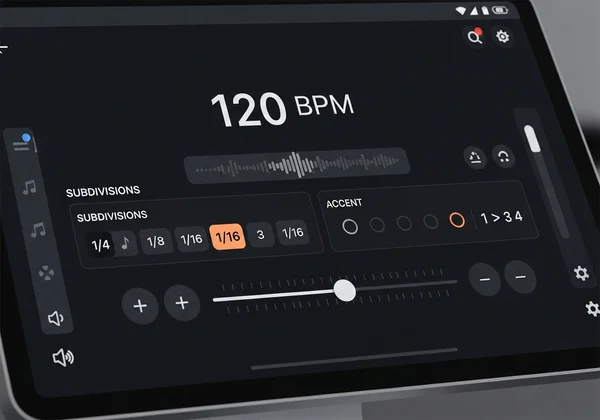
The most challenging part of metric modulation is hearing the new tempo before you switch to it. A great way to practice this is by setting your metronome to subdivide the beat. If you are modulating based on a triplet, set your metronome to sound out triplets. This allows your ear to lock into the rhythmic value that will become the new pulse. Our online tool lets you customize clicks and accents, making it easier to emphasize the subdivision you need to focus on.
Using Subdivisions for Precise Transitions
Precision is everything in metric modulation. The bridge between your old and new tempos is the subdivision. Your practice should involve these steps:
- Set your metronome to the starting tempo.
- Turn on the sixteenth-note subdivision clicks.
- Play along, but focus your listening on groups of three sixteenth notes (a dotted-eighth note).
- After a few bars, switch your internal pulse to feel that dotted-eighth note as the new "one."
- Stop the metronome, calculate the new tempo, and start it again to see how close you were.
Programming Gradual Tempo Shifts
While metric modulation is often a direct shift, some musicians practice with gradual tempo changes to build control. This involves slowly increasing or decreasing the BPM over several measures. Although not a direct metric modulation exercise, it develops your internal clock and control. You can manually adjust the slider on an online metronome tool to simulate this, pushing your rhythmic stability to its limits.
Advanced Rhythmic Exercises with Metric Modulation
Once you are comfortable with the concept and setup, it's time to dive into specific exercises. These drills are designed to build your rhythmic confidence and make complex tempo changes second nature. Start slowly and focus on accuracy above all else.
From 4/4 to 7/8: Common Metric Modulation Patterns
Changing time signatures is a common application of metric modulation. A popular pattern is moving from 4/4 to 7/8, keeping the eighth note's duration constant.
- Exercise: Set your metronome to a comfortable tempo in 4/4, for example, 80 BPM.
- Play a simple eighth-note pattern for several bars.
- After you feel stable, change your counting to seven eighth notes per bar instead of eight.
- The tempo of the eighth note remains the same, but the feel of the downbeat shifts. The metronome click, which once marked quarter notes, will now fall on different parts of the 7/8 bar. This forces you to rely on your internal pulse.
Triplets Against Sixteenth Notes: Building Complex Transitions
This exercise is excellent for developing rhythmic independence. The goal is to modulate using the triplet as a bridge.
- Exercise: Set your metronome to a slow tempo, like 60 BPM.
- First, play continuous sixteenth notes for four bars. Feel the four-note grouping per click.
- Next, switch to playing continuous eighth-note triplets for four bars. Feel the three-note grouping per click.
- Alternate between these two subdivisions. The true challenge is to switch seamlessly without losing the underlying quarter-note pulse from the metronome.
Polyrhythm Practice: Layering Multiple Time Signatures
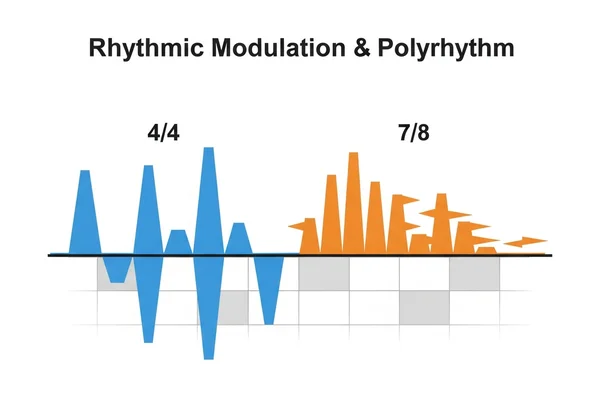
Polyrhythm is the simultaneous use of two or more conflicting rhythms. Practicing this is essential for mastering metric modulation.
-
Exercise: Set your metronome to a slow 4/4.
-
With your right hand (or foot), tap quarter notes along with the click.
-
With your left hand, try to tap a quarter-note triplet pattern over the 4/4 pulse. This is a classic "3 against 4" polyrhythm.
-
The goal is to keep both patterns steady without letting one influence the other. This drill directly trains your brain to handle the layered rhythms inherent in metric modulation.
Your Path to Mastering Advanced Rhythmic Transitions
Becoming comfortable with metric modulation takes consistent practice over time. It requires patience, precision, and the right tools. By understanding the theory, setting up your practice sessions correctly, and consistently working through targeted exercises, you can turn these complex rhythmic concepts into a powerful part of your musical expression.
Regular practice improves more than just your ability to change tempos. It deepens your overall musicianship, enhances your internal clock, and gives you the confidence to tackle rhythmically demanding music. Don't be afraid to experiment with different modulations and subdivisions.
Ready to start practicing with your metronome? Open our online metronome now and begin practicing metric modulation with the precision and flexibility you need to succeed.

Frequently Asked Questions About Metric Modulation and Metronome Use
What is the easiest way to calculate metric modulation ratios?
The simplest method is the "old equals new" formula. Decide which note value from your current tempo will become a new note value (e.g., "the old triplet eighth note equals the new quarter note"). Then, calculate the BPM of the old note value and make that the BPM for the new one. Using a BPM tool with tap tempo can also help you find tempos intuitively.
Can metric modulation be used in popular music, or is it only for classical compositions?
Absolutely! While it's a staple of avant-garde and classical music, metric modulation appears in jazz, progressive rock, fusion, and even some pop music. It's a versatile tool for any artist looking to add rhythmic interest and sophisticated transitions to their songs.
How long does it typically take to become comfortable with metric modulation exercises?
This varies greatly depending on your current rhythmic proficiency and practice consistency. For most musicians, it takes several weeks of dedicated practice to feel comfortable with basic modulations and several months to master more complex ones. The key is slow, accurate, and regular practice.
Is there a danger of over-relying on metronomes for metric modulation?
A metronome is a training tool. The initial goal is to use it to verify your accuracy. The ultimate goal is to internalize the feeling of these rhythmic shifts so you no longer need the metronome to execute them. Use it to build a solid foundation, then practice without it to test your internal clock.
What are some common mistakes musicians make when practicing metric modulation?
The most common mistake is practicing too fast. This leads to sloppy execution and reinforces bad habits. Another error is neglecting the subdivisions; focusing only on the main beat makes it nearly impossible to feel the rhythmic bridge. Always start slow and listen carefully to the smaller note values.