Metronome Mastery: Beginner to Advanced Rhythm Path
The feeling of rushing or dragging behind the beat is one of the most common frustrations musicians face at every level. Have you ever felt that your hands are moving faster than your brain during a difficult solo? Or perhaps you’ve noticed that your bandmates are constantly looking at you because the tempo seems to be drifting. These are signs that your internal clock needs a bit of fine-tuning.
Whether you're a beginner struggling to keep basic time or an intermediate player hitting complex rhythms, a structured approach to rhythm practice can transform your control. Rhythm is the heartbeat of music; without it, even the most beautiful melodies lose their impact. This comprehensive mastery path breaks down the journey from novice to advanced rhythmic proficiency into clear, manageable stages.
To begin this journey, you need a reliable partner. You can use this rhythm tool to set specific BPM recommendations, experiment with different time signatures, and reach your practice milestones. By the end of this guide, you will have a clear roadmap to becoming a "human metronome."
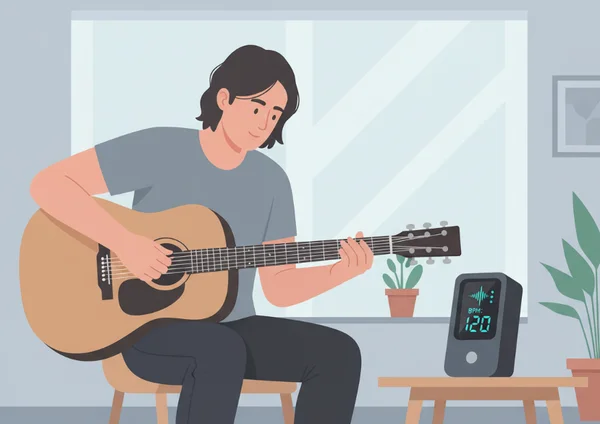
Understanding Your Starting Point: Metronome Assessment
Before you start training, you must know where you stand. Most musicians have a "natural tempo" where they feel comfortable. However, they often struggle when forced to play slower or faster than that zone. An assessment helps you identify these weak spots so you don't waste time practicing things you already know.
The Rushing vs. Dragging Test: Identifying Your Natural Tempo Tendency
Most people naturally tend to either rush (get faster) or drag (get slower). To find your tendency, open our online timing tool and set it to 60 BPM. Close your eyes and clap along for one minute. Suddenly, stop the click but keep clapping. After 10 seconds, turn the sound back on.
Are you still perfectly in sync with the pulse? If you find yourself clapping before the beat, you are a "rusher." If you are behind it, you are a "dragger." Knowing this allows you to focus your mental energy on resisting that specific pull during your practice sessions.
Time Signature Awareness: Evaluating Your Comfort with Common Rhythms
Not all rhythms are created equal. While most modern music sits comfortably in 4/4 time, many students struggle when the "pulse" changes. Ask yourself: Can I feel the heavy "one" in a 3/4 waltz as easily as a 4/4 rock beat?
Testing your awareness involves switching between these signatures at a steady tempo. If you lose your place when the accent moves from the fourth beat to the third beat, your time signature awareness needs work. Using a free practice tool that allows you to customize accents is the best way to bridge this gap.
Rhythmic Dictation Exercise: Testing Your Ability to Replicate Complex Patterns
Advanced rhythm isn't just about keeping a pulse; it’s about understanding the space between the pulses. Try a simple dictation exercise: listen to a short drum loop or a syncopated bass line. Can you immediately identify where the "downbeats" and "upbeats" are?
If you cannot tap along to a complex pattern without losing the main pulse, your brain isn't yet "subdividing" the beat. This is a diagnostic sign that you need to spend more time on subdivision training, which we will cover in the foundations section.
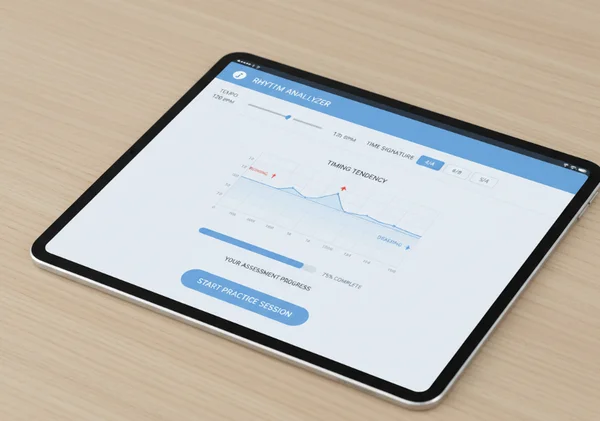
Building Foundations: Beginner Metronome Exercises (40-80 BPM)
The biggest mistake beginners make is practicing too fast. Professional musicians know that the real challenge lies in playing very slowly. When there's a wide gap between clicks, there's more room for error. The real challenge is maintaining perfect timing at slower speeds. At these tempos, even tiny timing deviations become noticeable.
The Quarter Note Foundation: Mastering Steady Pulse at 40 BPM
At 40 BPM, there is 1.5 seconds between every click. This feels like an eternity in music. Your goal here is to hit the click so perfectly that the sound of the device seems to disappear behind your own note. This is often called "burying the click."
Start by playing a single note on your instrument or clapping your hands. Don't just wait for the sound; try to "feel" the space moving toward it. If you can stay perfectly on the beat at 40 BPM for two minutes without drifting, you have a rock-solid foundation. You can try this tool to set your BPM to 40 and start your foundational training today.
Simple Time Signatures: 2/4, 3/4, and 4/4 at 60 BPM
Once you can hold a pulse, it’s time to organize those pulses into measures.
- 2/4 Time: Focus on a "Strong-Weak" pattern (common in marches).
- 3/4 Time: Focus on "Strong-Weak-Weak" (the waltz feel).
- 4/4 Time: The standard "Strong-Weak-Medium-Weak" pattern.
Set your device to 60 BPM and practice switching between these signatures every four measures. This teaches your brain to anticipate the "Downbeat" (the first beat of the measure), which is essential for playing with other musicians.
Subdivision Training: Adding Eighth Notes to Your Foundation at 70 BPM
Subdivision is the act of mentally dividing the beat into smaller parts. Instead of just hearing "1, 2, 3, 4," you start hearing "1-and, 2-and, 3-and, 4-and." At 70 BPM, practice playing two even notes for every one click.
This prevents you from "guessing" where the next beat is. By filling the silence with internal eighth notes, you create a much more stable rhythmic structure. This is the first step toward playing faster, more complex music without losing control.
Developing Consistency: Intermediate Metronome Practice (80-120 BPM)
In the intermediate stage, the goal shifts from just "hitting the beat" to "internalizing the beat." You want to reach a point where you don't need external help to keep you steady, but rather use a device to verify your own internal clock.
Mastering the "Click" Internalization: Playing Without the Metronome at 80 BPM
A great technique for internalization is "Gap Training." Set your BPM tool to 80 BPM. Many advanced timing apps allow you to mute certain measures. Try playing for three measures with the click on, and one measure with the sound silent.
If you're consistently off when the click returns on the fifth measure, you're relying too heavily on the external sound. Your internal clock needs more independent development. Practice until you can go two or even four measures in silence and still land perfectly on the "one" when the sound returns.

Complex Time Signatures: 6/8, 5/4, and 7/8 at 100 BPM
Now we move away from the "even" feeling of 4/4 time.
- 6/8 Time: Feels like two groups of three (1-2-3, 4-5-6). It has a swinging, triplet feel.
- 5/4 and 7/8 Time: These are "odd" meters. They feel "lopsided" because they don't divide into equal halves.
Practicing these at 100 BPM helps you get comfortable with musical patterns that don't fit into standard boxes. This is vital for jazz, progressive rock, and classical music. Use a customizable rhythm tool to set these specific signatures and hear how the accents change.
Syncopation Training: Playing "Off the Beat" at 120 BPM
Syncopation is when you emphasize the "weak" beats or the "and" between the beats. At 120 BPM, try playing only on the "upbeats." If the click says "1, 2, 3, 4," you play only on the "ands" in between.
This is incredibly difficult because your brain naturally wants to align with the heavy click. Mastering syncopation is what gives music "groove" and "soul." It’s the difference between a robotic performance and one that makes people want to dance.
Advanced Rhythmic Control: Professional Metronome Techniques (120+ BPM)
At the professional level, timing tools become a way of pushing the boundaries of what is physically and mentally possible. We move into the territory of polyrhythms and high-speed precision.
Polyrhythm Development: 2 Against 3 at 120 BPM
A polyrhythm occurs when you play two different rhythmic patterns at the same time. The most common is "3 against 2." Imagine your right hand playing three even notes while your left hand plays two even notes in the same amount of time.
This sounds complex, but it creates a beautiful, rolling texture. To practice this, set your online tool to a triplet setting and try to tap a steady duple rhythm against it. It requires total independence of the limbs and a high level of mental focus.
Speed Bursts: Building Tempo Flexibility from 120 to 140 BPM
Building speed isn't about playing fast all the time; it’s about controlled bursts. Try the "Speed Burst" method: play a scale at 120 BPM, then suddenly play a four-note burst at 140 BPM, then return to 120 BPM.
This trains your muscles to relax at high speeds. If you tense up, you will hit a "speed wall." These bursts teach your nervous system that 140 BPM is not scary or chaotic, but just another controlled speed.
Precision at High Speed: Maintaining Accuracy at 160+ BPM
At 160+ BPM, there's no time to think—everything must be muscle memory. However, many musicians become "sloppy" at high speeds, hitting notes slightly early or late. This can ruin an otherwise perfect performance.
To fix this, use a free rhythm aid with a high-pitched, sharp click. At 160+ BPM, the tiniest deviation becomes obvious. Practice short patterns—only 4 to 8 notes—and ensure every single one is crystal clear and perfectly placed. If it’s not perfect, drop the tempo by 10 BPM and start again.
Your Rhythmic Journey: Next Steps in Metronome Mastery
Mastering rhythm isn't about reaching a final destination—it's about embracing a lifelong journey that will transform your music. Even the world's greatest virtuosos return to their timing aids daily to keep their internal clock sharp. By following this path—from 40 BPM foundations to 160+ BPM precision—you're building a skill that brings professional polish to every note you play.
The most important takeaway is consistency. Five minutes of focused practice every day is much better than two hours once a week. Your brain needs regular "calibration" to keep its internal clock accurate.
Ready to take the first step? Head over to the homepage and start your assessment. Whether you are a beginner or a pro, our tool has the features you need to master your rhythm. Happy practicing!
Frequently Asked Questions About Metronome Mastery
How long should I practice with a metronome each day?
For most students, 10 to 15 minutes of dedicated rhythm practice is enough to see significant improvement. It is best to integrate a steady pulse into your regular warm-ups or scale exercises. Start by setting a specific goal for each session, such as staying on the beat for two minutes at 60 BPM.
What's the best BPM to start metronome practice as a beginner?
While it depends on the exercise, 60 BPM is generally the best starting point. It is slow enough to be challenging but fast enough that you don't lose the sense of the pulse. As you get comfortable, try dropping down to 40 BPM to test your true stability.
How do I know when I'm ready to move to the next level?
You are ready to move up when you can play an exercise perfectly for three days in a row. This means you are not rushing, not dragging, and you feel relaxed. If you find yourself tensing your shoulders or holding your breath, stay at your current level until the movement feels natural.
Can using a metronome actually improve my natural rhythm?
Yes, absolutely. A timing tool acts like a mirror for your rhythm. Just as a mirror shows you if your posture is wrong, the click shows you where your timing is off. Over time, your brain records the steady pulse, and you will stay in time even when the tool is turned off.
What should I do if I always rush or drag behind the beat?
First, don't get frustrated—it's very common! Use the tap tempo feature on our site to find the speed you are naturally playing. Then, set the device to that exact speed. Once you are in sync, lower or raise the BPM by only 2 or 3 beats. Small changes are easier for your brain to process than large jumps.