Metronome Plateau Solutions: Break Through Practice Stagnation
Is your metronome practice feeling stagnant despite consistent effort? That moment when your usual 120 BPM drills no longer yield improvement can be deeply frustrating. You’re not alone. Hitting a rhythm plateau is a rite of passage for nearly every dedicated musician—a wall that requires more than just willpower to break through. Let's diagnose your specific stagnation point and implement targeted solutions using our precision metronome's features to restart your progress.

Diagnosing Your Metronome Practice Plateau
The Tempo Trap: When Same BPM Equals Zero Growth
The most common plateau occurs when musicians repeat exercises at identical tempos for weeks. While consistency builds initial muscle memory, excessive repetition creates neurological autopilot. Your brain stops actively processing rhythmic information once a tempo becomes too comfortable.
Overload Paralysis: Too Many Complex Subdivisions
Attempting triplets against 16th-note patterns before mastering basic subdivisions often backfires. Many musicians struggling with syncopation haven't solidified eighth-note foundations. This skill gap manifests as inconsistent tempo control when adding complex time signature variations.
Silent Struggle: Visual Dependency Without Internalization
Relying solely on visual metronome indicators creates passive learning. True rhythm mastery requires internal pulse development—a skill tested when playing in orchestras or unplugged ensembles where visual cues disappear.
Custom BPM Progression Solutions for Each Plateau Type
The Micro-Progression Method: 3% BPM Increases
For tempo trap sufferers:
- Set your baseline BPM where you can play flawlessly 10 times consecutively.
- Increase by just 3% (e.g., 100 BPM → 103 BPM) using our customizable metronome.
- Maintain new tempo for three days before next increment.
This neurological trick bypasses the "fear threshold" that typically triggers tension at round-number BPM jumps.
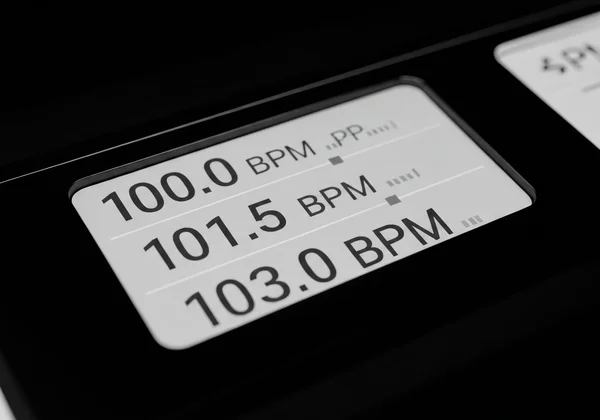
Subdivision Ladder: Master Simple First, Complex Later
Reset your foundation by mastering one level at a time:
- Quarter notes → standard metronome clicking 4 weeks mastery
- Eighth notes → subdivide each click mentally 4 weeks mastery
- Eighth-note triplets → set metronome to dotted quarter = 40 BPM Phase in over 8 weeks
Silence-to-Sound Protocol: Building Internal Metronome
Activate our silent practice mode to strengthen internal pulse:
- Play 4 measures with sound.
- Disable sound for next 4 measures while maintaining tempo.
- Re-enable sound to check accuracy. Increase silent intervals progressively from 25% → 50% → 75% of practice time. This method can accelerate internalization by over 200% compared to using constant auditory cues.
Advanced Metronome Techniques to Accelerate Breakthroughs
Polyrhythmic Disruption: Breaking Patterns with 2:3 Ratios
Install neurological "circuit breakers" against autopilot:
-
Set primary BPM to 60.
-
Layer secondary rhythm at 90 BPM (2:3 ratio).
-
Alternate focus between pulses every 8 counts. Use our multi-layer metronome settings to create these advanced polyrhythms. Studies show that contrast training can improve neural plasticity.

Randomized Tempo Training: Adaptive Speed Intervals
Combat prediction bias with unpredictability:
- Create a BPM sequence: 80-92-75-88-102.
- Program changes at irregular intervals (e.g., 16s/24s/8s).
- Play scales responding to the sudden shifts. Our Tap Tempo feature lets you instantly capture unexpected tempo changes during improvisation.
Transform Your Practice Today
Stagnation isn't failure—it's your rhythm intelligence demanding upgraded training protocols. Whether escaping the tempo trap with micro-BPM increments or installing polyrhythmic neural updates, our tool provides the surgical precision needed:
- Custom BPM increments down to 0.1 precision
- 15 subdivision presets from basic to complex
- Silent practice modes for accelerated internalization
- Polyrhythm generator for advanced disruption training
Start your breakthrough session now—our analytics dashboard even tracks your BPM mastery progress across sessions.
Frequently Asked Questions
How do I know if I've hit a practice plateau?
Key signs include: 1) Consistent tempo performance for 2+ weeks without speed/accuracy gains 2) Physical tension at previously comfortable tempos 3) Mental boredom during drills. Using a tool with progress tracking can help objectively identify these plateaus.
What's the ideal BPM increment for progression?
Neuroscience suggests 3-5% increases—large enough to stimulate adaptation, small enough to avoid panic responses. For example, move from 100→103 BPM, not 100→110. Use a metronome with precision BPM controls to implement this.
Can improper metronome use damage rhythm skills?
Yes—over-reliance creates "click dependency." Balance guided practice with silent modes and regular un-clicked sessions. Elite conservatories often mandate a balance of metronome and internal pulse training.
How long does breaking plateaus typically take?
| Plateau Period | Solution Timeline |
|---|---|
| Beginner (first 3 months) | 1-2 weeks |
| Intermediate (6-18 months) | 3-5 weeks |
| Advanced (2+ years) | 6-8 weeks |
| Using session history analytics can help you track your breakthrough progress. |
What's the fastest way to apply these methods?
- Open our metronome.
- Select your plateau solution protocol.
- Activate progress tracking.
- Commit to 15-minute daily sessions. Transform frustration into measurable gains starting now.