Metronome Teaching Strategies: Free Online Tools for Rhythm Development
Many music teachers face a common challenge: students who play the right notes but cannot keep a steady beat. This "rhythm crisis" often leads to frustration for both the teacher and the student. Have you ever wondered how to make rhythm practice more engaging and less like a chore?
The answer lies in moving beyond simple clicking. By integrating structured metronome teaching strategies into your curriculum, you can transform how your students perceive time. Using a high-quality free metronome tool allows students to visualize the beat, not just hear it. This guide provides a comprehensive path to building rhythm proficiency through systematic lesson plans.
Why Traditional Metronome Use Fails in Music Education
In many classrooms, the metronome is introduced too late or used only when a student makes a mistake. This creates a negative association. If a student only hears the "click" when they're doing something wrong, they'll naturally resist the tool. To improve, we must change our rhythm lesson plans to focus on positive reinforcement and skill building.
Common Student Resistance and How to Overcome It
Students often call metronomes "distracting" or claim they "kill the vibe." Why? Their internal rhythm hasn’t caught up to the beat. Start small: clap before you play. This builds a physical connection to the tempo before adding the complexity of an instrument.
The Metronome as Punishment vs. Training Tool
Many students view the metronome as a "critic" that points out flaws. As an educator, your first goal is to rebrand the device. Explain that the metronome is a "rhythm coach." Just as an athlete uses a stopwatch to track speed, a musician uses a metronome to track consistency. When students use an online metronome, they should feel they're gaining control over their performance, not being restricted by it.
Assessing Your Students' Current Rhythm Proficiency
Before starting a new curriculum, you've got to know where your students stand. Ask them to clap a steady 4/4 beat at 80 BPM without help. Then, turn on the metronome and see if they're ahead or behind. You can use a BPM tool to test their ability to match different speeds. Recording these sessions helps students hear their own progress objectively.
Building Your Progressive Metronome Curriculum Framework
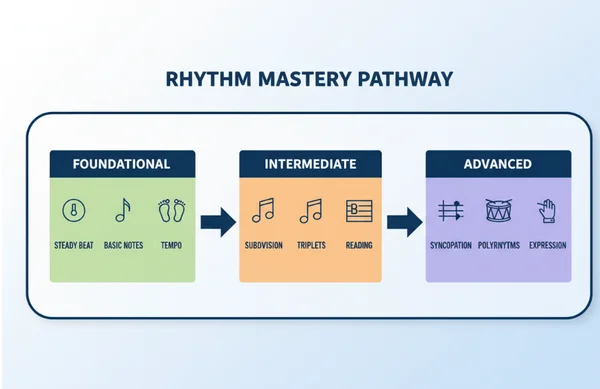
A successful rhythm program should be progressive. You can't expect a beginner to play complex syncopation if they can't hold a steady quarter note. We recommend a 12-week framework designed to build "internalized timing." This approach ensures that the metronome eventually becomes a part of the student's inner musicality.
Foundational Level: Mastering Steady BPM (60-72 BPM Range)
The first month should focus entirely on the "big beat." Use a slow tempo, between 60 and 72 BPM. At this stage, the goal is "ensemble playing" with the metronome.
- Week 1: Clapping on beats 1 and 3.
- Week 2: Clapping on all four beats.
- Week 3: Playing open strings or single notes along with the click.
- Week 4: Introducing the "Tap Tempo" concept. Have students try to match a beat they hear in their head by using a customizable metronome to find the exact speed.
Intermediate Level: Complex Time Signatures & Subdivision (Weeks 5-8)
Once the pulse is steady, it’s time to break the beat down. This is where "subdivision" becomes vital. Students should learn to hear eighth notes and triplets inside the main beat.
- Week 5: Introduction to 3/4 and 6/8 time signatures.
- Week 6: Practicing eighth-note subdivisions.
- Week 7: Moving between duple (2) and triple (3) patterns.
- Week 8: Using different "sounds" on the metronome. For example, using a cowbell sound for the downbeat and a woodblock for the subdivisions helps the ear distinguish the structure of the measure.
Advanced Level: Expression Within Precision (Weeks 9-12)
The final stage is about "musicality." Many people think metronomes make music sound robotic. In reality, you need a perfect pulse to understand where you can safely "push" or "pull" the tempo for emotional effect.
- Week 9: Polyrhythms (e.g., 2 against 3).
- Week 10: Increasing speed in small increments (2 BPM at a time).
- Week 11: The "Silent Measure" challenge. Set the metronome to play for two measures and then go silent for two. The student must stay on the beat during the silence.
- Week 12: Performance at the goal tempo.
Four Complete Lesson Templates for Immediate Implementation
To help you get started, here are four music educator tools in the form of lesson templates. You can adapt these for various instruments and group sizes. Each template focuses on a specific rhythmic challenge common in music education.
Beginner Piano Lesson: Steady Quarter Note Foundation
Goal: To help the student play a five-finger scale without rushing.
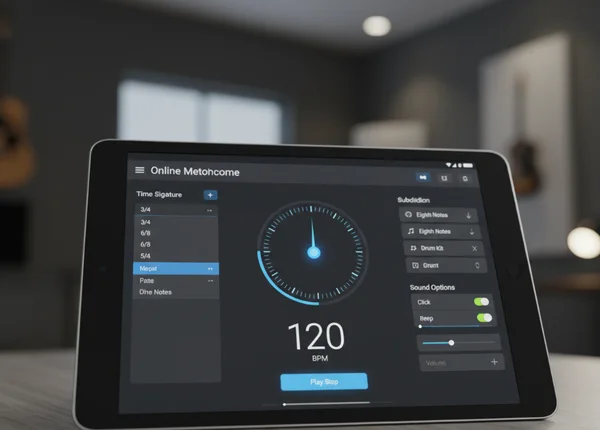
- Open the online metronome and set it to 60 BPM.
- Have the student "ghost play" (tapping fingers on the wood of the piano) along with the click.
- Ask the student to play the C major scale, one note per click.
- If they succeed, increase the speed to 64 BPM. If they rush, drop to 56 BPM to build patience.
String Ensemble Lesson: Synchronized Bowing Practice
Goal: To align the bow changes of the entire section.
- Set the metronome to a moderately slow tempo (e.g., 72 BPM).
- Instruct the violins to change bow direction exactly on the downbeat.
- Use a high-volume "snare drum" or "cowbell" sound from the metronome settings so everyone can hear it over the instruments.
- Focus on the "attack" of the note. The sound should start exactly when the click happens.
Band Classroom: Counting Complex Meters
Goal: Teaching students to navigate 5/4 or 7/8 time signatures.
- Use a time signature metronome to set a 5/4 pattern.
- Set a distinct accent on beat 1 and a secondary accent on beat 4 (3+2 grouping).
- Have the students chant "1-2-3, 1-2" along with the clicks.
- Once the vocal rhythm is solid, have the brass and woodwinds play a concert Bb on the accented beats only.
Private Studio: Individualized Rhythm Development
Goal: Fixing a "trouble spot" in a specific piece of music.
- Identify the difficult measure.
- Set the metronome to 50% of the target performance speed.
- The student must play the measure three times in a row perfectly before increasing the speed by 4 BPM.
- Encourage the student to use this metronome at home to track their "Daily High Speed" for that specific passage.
Assessment Metrics: Measuring Rhythm Improvement Objectively
Grading rhythm feels subjective, right? Not anymore. Track BPM progressions or recovery speed—then show parents their child’s journey from 60 to 100 BPM. This data-driven approach builds confidence and provides a clear roadmap for future lessons.
Creating Customizable Rubrics for Rhythm Skills
A rhythm rubric should go beyond "pass/fail." Consider these categories:
- Pulse Stability: Does the student stay with the click for 16 measures?
- Subdivision Accuracy: Are eighth notes even, or are they "swinging"?
- Recovery: If the student makes a mistake, how quickly can they jump back into the beat?
- Tempo Range: What is the slowest and fastest tempo the student can play this piece accurately?
Digital Tools for Tracking Progress Over Time
In the modern classroom, music educator tools often include digital logs. Encourage students to keep a "Practice Diary." Each entry should list the exercise, the starting BPM, and the ending BPM. Seeing a graph of their speed increasing from 60 BPM to 120 BPM over a month is a powerful motivator for young learners.
Parent-Teacher Communication: Demonstrating Growth
Parents often ask, "How is my child doing?" Instead of saying "they're getting better," you can say, "Last month, Sarah could only stay on beat at 80 BPM. Now, she can accurately play 16th notes at 100 BPM." This level of detail shows professional expertise and proves that your metronome teaching strategies are working.
Implementing Your Metronome Revolution: From Theory to Classroom Practice
Think rhythm is just natural talent? Think again. Like training for a marathon, steady timing is a muscle you strengthen—and we’ll show your students how. By using a structured curriculum and professional tools, you can turn the metronome from a "hated click" into a student's best friend.
Consistency turns struggle into skill. Start small: a 2-minute rhythm warm-up at every lesson works wonders. Encourage your students to use the tap tempo feature to explore the pulse of their favorite songs. When rhythm becomes a game of precision rather than a test of "feeling," students relax and play better. Visit Metronome.wiki today to access the tools you need to start your rhythm revolution in the classroom!
FAQ Section
How can I make metronome practice engaging for young students?
Try gamifying the process! Use a "High Score" system where students earn points for every 5 BPM they increase while maintaining accuracy. You can also use different fun sounds on the metronome, like a woodblock or a triangle, to keep the auditory experience fresh.
What are the most effective metronome settings for beginning musicians?
For beginners, a simple 4/4 time signature with a clear accent on the first beat is best. Set the tempo between 60 and 80 BPM. Avoid using complex subdivisions until they can comfortably clap along with the quarter notes. You can access these presets with our free online metronome tool.
How do I assess rhythm development in my classroom?
The most objective way is to record the student playing with a metronome and then listen back together. Often, students don't realize they're rushing until they hear the recording. Use a rubric that tracks pulse stability, recovery time, and accuracy of subdivisions.
Can metronome practice help students with performance anxiety?
Yes! Much of performance anxiety comes from a fear of losing control. When a student has practiced extensively with a steady pulse, their "muscle memory" for the timing becomes much stronger. This gives them a "safety net" to fall back on if they feel nervous during a recital.
How often should students practice with a metronome at home?
Ideally, a metronome should be used during at least 50% of every practice session. It’s especially important during the technical warm-up and when first learning a new piece. Using a mobile-friendly free metronome makes it easy for students to practice anywhere.