Online Metronome Practice Tips: Play Musically, Not Like a Robot
Does your metronome feel more like a drill sergeant than a helpful guide? You're not alone. Many musicians struggle to integrate a metronome into their practice without sounding stiff. This guide will transform your practice, helping you internalize the beat and add beautiful expression while maintaining flawless time. To truly master effective metronome use, these expert metronome practice tips will help you move beyond rigid clicking to truly play musically with our free online metronome.
The Metronome's True Purpose: Your Internal Rhythm Coach
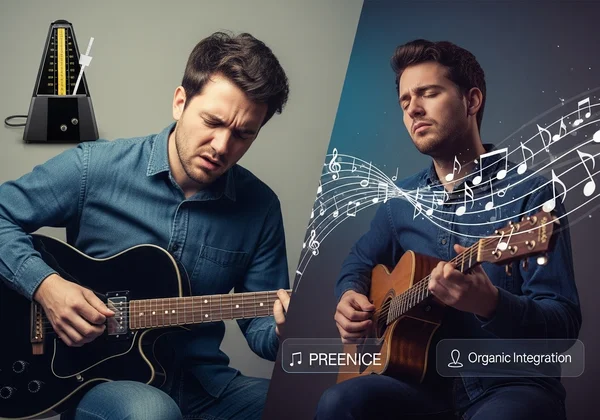
Before diving into advanced techniques, we must reframe our relationship with the metronome. It’s not a robotic overlord demanding perfect conformity; it's a coach designed to train your internal sense of time. When your playing sounds stiff, the fault isn't the tool, but how it's being used. The goal is to become so rhythmically stable that you no longer need the external click.
Why 'Stiff' Happens: Understanding Common Metronome Misconceptions
Many players develop a dependent relationship with their metronome. They listen for the next click and react to it, constantly playing catch-up. This reactive playing creates a tense, robotic feel because there's no forward momentum or groove. The musician isn't feeling the pulse within the music; they're just trying not to miss the beep. This is a crucial distinction that separates amateur timing from professional rhythm.
From External Click to Internal Pulse: The Ultimate Goal of Rhythmic Mastery
The true goal of metronome practice is to absorb the steady tempo so deeply that it becomes your own. A great musician doesn't follow the click; they are the click. Their internal pulse is so strong that the metronome merely confirms what they already feel. Every exercise in this guide is designed to help you transition from relying on an external sound to trusting your own innate sense of rhythm. Ready to build that internal clock? Let's begin.

Techniques to Play Musically with Your Metronome
Moving from robotic to rhythmic requires specific, actionable strategies. These techniques train your brain to hear the space between the clicks, which is where music truly lives.
Subdivision Mastery: Hearing Between the Clicks and Feeling the Groove
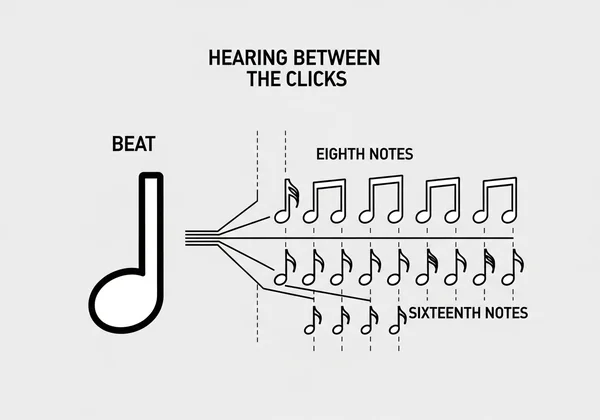
If you only focus on the main beats (1, 2, 3, 4), your rhythm will lack depth. Subdivision is the practice of feeling the smaller rhythmic units between each click. For example, if the metronome is clicking quarter notes, you should mentally (or physically) feel the eighth notes ("1-and-2-and") or even the sixteenth notes ("1-e-and-a-2-e-and-a").
Start by setting our online metronome tool to a slow tempo, like 60 BPM. Play a simple scale, but for every click, play two even notes (eighth notes). Focus on making the space between the clicks perfectly even. As you get comfortable, try playing four notes per click (sixteenth notes). This practice forces you to take responsibility for the time between the beats, which is the foundation of creating a musical groove.
Silent Practice Intervals: Trusting Your Inner Metronome for Fluidity
This exercise is a powerful test of your internal clock. Many modern digital metronomes, including ours, can be programmed to play for a certain number of bars and then be silent for the same number. This feature is perfect for checking if you are truly internalizing the beat.
Set the metronome to play for two bars and then be silent for two bars. Your task is to continue playing through the silent bars and land perfectly on the downbeat when the click returns. If you rush or drag, you'll immediately know when the metronome comes back in. Start with a simple two-bar cycle and gradually increase the silent period to four or even eight bars to challenge your internal rhythm.
Overcoming the 'Robotic Sound': Advanced Metronome Strategies
Once you've mastered the fundamentals, you can use the metronome in more creative ways to develop a sophisticated and flexible sense of time. These strategies are designed to break the habit of playing "on top" of the beat and instead teach you how to play with it.
Clicking on Off-Beats (2 & 4): Enhancing Your Musical Feel
This technique can significantly enhance your feel in genres like jazz, funk, rock, and pop. Instead of having the metronome click on every beat (1, 2, 3, 4), set it to half the tempo and think of the clicks as beats 2 and 4. For example, to practice a song at 120 BPM, set your BPM to 60.
Now, count "1, 2, 3, 4," with the click only sounding on the bolded beats. This forces you to feel the "one" and "three" on your own, developing a much stronger sense of swing and groove. It will feel challenging at first, but mastering this technique is a massive step toward achieving a professional musical feel.
Dynamic Practice: Shaping Phrasing and Expression with the Beat
Robotic playing is often dynamically flat. Music needs shape—moments of tension and release created through changes in volume (dynamics). Use the metronome as a steady rhythmic foundation while you practice shaping your musical phrases.
Choose a simple melody or scale. As you play with the metronome, practice making a crescendo (getting louder) over four bars and then a decrescendo (getting softer) over the next four. The steady click ensures your tempo doesn't fluctuate as your volume changes—a common challenge for many musicians. This exercise connects your rhythmic accuracy to your emotional expression.
Improve Your Musical Timing: Beyond Strict Adherence to the Beat
Truly great timing isn't just about being accurate; it's about being flexible. It's about understanding how to place a note slightly ahead of the beat for excitement or slightly behind it for a relaxed feel—all while knowing exactly where the center of the beat is.
The Gradual Tempo Approach: Slow Practice to Expressive Performance
One of the most effective ways to learn a difficult passage is to practice it flawlessly at a slow tempo and gradually speed it up. Start at a speed where you can play the music perfectly, with no mistakes. After a few successful repetitions, increase the tempo on our BPM tool by 2-4 beats per minute.
This methodical process builds muscle memory and confidence without introducing tension. Rushing to play at full speed ingrains mistakes and creates a "robotic" sound because your brain is too busy trying to keep up to think about musicality. Slow, deliberate practice is the secret to fast, clean, and expressive playing.
Using Our Metronome's Tap Tempo: Finding Your Natural Flow
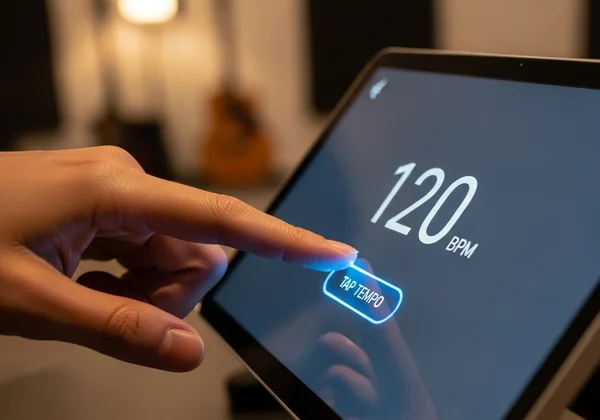
Sometimes the tempo marked on the page doesn't feel right, or you're trying to find the pulse of a song you've just heard. Our metronome's Tap Tempo feature is invaluable for this. Simply tap along to the rhythm you feel in your head or hear on a recording, and the tool will instantly tell you the BPM.
Unlock Your Musical Potential
The metronome is one of the most powerful tools in a musician's arsenal, but only when used correctly. By moving beyond reactive clicking and using these advanced techniques, you can transform it from a rigid taskmaster into a trusted partner in your musical journey. It's time to stop sounding robotic and start making truly expressive, rhythmically solid music.
Open our customizable metronome right now, set it to a slow tempo, and try one of these techniques. You'll be amazed at how quickly your playing starts to feel more alive, groovy, and musical.
Frequently Asked Questions About Metronome Practice & Musicality
How can I use a metronome effectively to improve my rhythm and musicality?
The most effective way is to use it as a tool for internalizing the beat. Practice subdivisions to feel the space between clicks, use silent intervals to test your internal clock, and work on advanced exercises like placing the click on off-beats. Always start slow and focus on perfect execution before increasing speed. Our online metronome is perfect for these exercises.
Can a metronome truly help me play more musically, or just technically accurate?
Absolutely. While it builds technical accuracy, its ultimate purpose is to give you such a strong internal sense of time that you are free to focus on musicality—dynamics, phrasing, and emotion. By handling the rhythm, the metronome liberates your mind to be more expressive, not less.
What is a good BPM to start practicing new pieces with a metronome?
There is no single "good" BPM; the right tempo is the one at which you can play a passage perfectly without any stumbles. For a very difficult section, this might be as slow as 40 or 50 BPM. The key is to find the speed of flawless execution and gradually build from there using a reliable metronome online.
Is 'playing in the pocket' the same as playing exactly with the metronome's click?
Not exactly. "Playing in the pocket" refers to a state of deep rhythmic alignment with a groove, often shared by a whole band. While it requires a strong sense of time, it also involves a subtle rhythmic feel—sometimes playing slightly ahead of the beat or laying back just behind it. Practicing with a metronome gives you the control and awareness to make those intentional, musical choices, which is the essence of playing in the pocket.