Tap Tempo: Find Song BPMs Like a Pro
The frustration is universal among musicians, producers, and even dedicated music fans. You hear an amazing song with an infectious groove and immediately wonder, "What is the tempo of this track?" Whether you want to learn it on your instrument, sample it for a new beat, or just understand its rhythmic DNA, knowing the exact BPM (Beats Per Minute) is crucial. Guessing is often inaccurate, and searching online can be fruitless for more obscure songs.
The Tap Tempo feature is your secret weapon. It's a simple yet powerful function that lets you determine a song's tempo with just a few taps of your finger. By the end of this guide, you'll move from guessing tempos to identifying and setting precise BPMs like a seasoned musician. Ready to unlock a new level of musical precision? The journey starts with a simple, free tool you can access right now. You can get started immediately with our online metronome.
Understanding Tap Tempo Fundamentals
Before you can master the technique, it’s important to understand what Tap Tempo is and how it works its magic. This isn't just about randomly tapping; it’s about a smart calculation that translates your physical rhythm into a precise digital number. By grasping the fundamentals, you'll use the feature more accurately and effectively.
What Is Tap Tempo and How Does It Work?
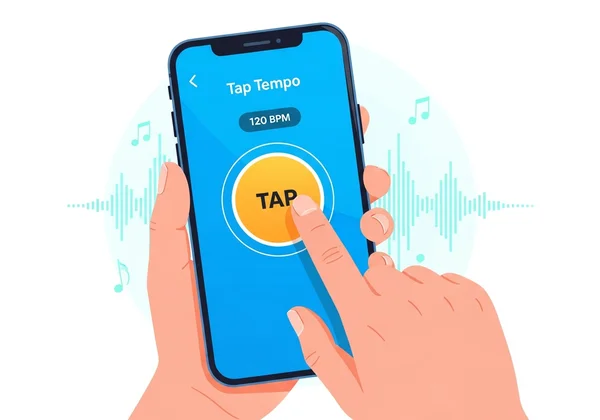
Tap Tempo is a feature found on many digital metronomes, drum machines, and music software that calculates the tempo based on the user's taps. Instead of manually scrolling through BPM values, you simply tap along to the beat of a song you're hearing or a rhythm you have in your head. The tool measures the time between your taps and converts it into a BPM value.
The process is straightforward:
- You listen to the music and identify the main beat, usually the kick or snare drum.
- You tap a button or a designated area on the screen in time with that beat.
- The software calculates the average interval between your taps.
- This interval is then used to display the tempo as a precise BPM number.
It’s an intuitive bridge between human rhythm and digital accuracy, allowing you to quickly capture the pulse of any piece of music.
The Science Behind Accurate BPM Detection
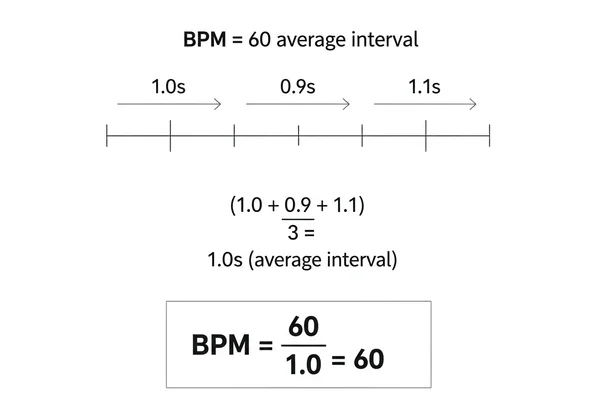
At its core, Tap Tempo is a simple mathematical function. The tool records the exact moment you make each tap (a timestamp). It then calculates the duration, or interval, between consecutive taps. For example, if you tap twice with exactly one second between the taps, the interval is 1 second.
Since there are 60 seconds in a minute, the formula to find the BPM is: BPM = 60 / (average interval in seconds). In our example, 60 / 1 second equals 60 BPM. If you tap every half-second, the calculation would be 60 / 0.5, resulting in 120 BPM.
To improve accuracy, a good Tap Tempo tool doesn't just rely on two taps. It averages the intervals over several taps (usually 4 to 8). This averaging process smooths out slight human inconsistencies, giving you a much more stable and reliable BPM reading. The more consistent your taps are, the more accurate the result will be.
Professional Techniques for Precise Tempo Detection
Just knowing what Tap Tempo is isn't enough; using it like a professional requires technique. A few simple strategies can dramatically improve your accuracy, helping you lock in the correct BPM even with complex or fast-paced music. These methods separate the amateurs from the experts.
The 3-Tap Method for Quick Estimates
When you need a tempo fast, the 3-Tap Method is your go-to technique. It's perfect for quickly capturing an idea or getting a rough estimate during a live rehearsal. As the name implies, you simply tap along to the beat three times. While not as precise as using more taps, it's incredibly efficient.
The key is to focus on the downbeat. Find the "one" of each measure and tap firmly on it. This gives the algorithm a clear, strong pulse to work with. This method is excellent for straightforward songs in 4/4 time. It provides a solid baseline BPM that you can refine later if needed. For a fast and responsive experience, you can try our tool right now.
Advanced Averaging Strategies for Complex Rhythms
For songs with syncopation or intricate rhythms, a few quick taps might not be enough. This is where advanced averaging helps. Instead of just tapping three or four times, continue for a longer duration—at least 8 to 16 beats.
Tapping for an extended period gives the algorithm more data to work with. This helps calculate a more accurate average, filtering out minor timing errors. This technique is essential for producers analyzing samples or musicians transcribing a tricky solo. The longer you tap in time, the more confident you can be in the resulting BPM.
Finding Tempos in Music with Unusual Time Signatures
What about music that isn't in a simple 4/4 time? Songs in 3/4 (waltz time), 6/8, or 7/8 can be tricky. The secret is to identify the main pulse of the music. Don't get distracted by every single note; listen for the foundational beat that drives the song forward.
In 3/4 time, this is typically the first beat of each measure (ONE-two-three, ONE-two-three). In 6/8 time, there are often two main pulses per measure (ONE-two-three-FOUR-five-six). Once you identify this primary pulse, tap along to it. Our Tap Tempo feature is designed to handle this, translating your taps into a correct BPM regardless of the time signature.
Practical Applications in Real-World Scenarios
Understanding how to use Tap Tempo is one thing, but applying it to your daily musical life is where it truly shines. From learning new songs to perfecting difficult passages, this feature can become an indispensable part of your workflow, saving you time and boosting your confidence.
Transcribing Music with Confidence
For any musician who learns songs by ear, transcribing can be a tedious process. Getting the rhythm and timing right is often the hardest part. Tap Tempo removes the guesswork entirely. Before you even write down the first note, you can use it to determine the song's exact BPM.
Once you have the tempo, you can set a metronome to that BPM. This creates a rhythmic grid for your transcription. You’ll be able to place notes and rests with far greater accuracy, ensuring your final sheet music or tab is a true representation of the original performance. It’s like having a rhythmic blueprint before you start building.
Setting Practice Tempos for Challenging Passages
Every musician encounters a passage that feels impossibly fast. The key to mastering it is to practice slowly and gradually increase the speed. But what is "slow"? And how do you measure your progress?
Tap Tempo helps you find a comfortable starting point. Play the difficult section as slowly as you need to in order to play it perfectly, and tap along to find that initial BPM. Set your metronome to that tempo and practice until it feels effortless. Then, increase the BPM by 2-4 beats and repeat. This methodical approach ensures steady progress and builds muscle memory correctly. Our customizable metronome is perfect for this kind of structured practice.
Your Next Steps in Tempo Mastery
You now have the knowledge to find song BPMs like a professional. From understanding the science behind the tool to applying advanced techniques for complex music, you are equipped to master any tempo you encounter. Remember that true mastery develops through consistent, deliberate practice. Start by using Tap Tempo on songs you know well to calibrate your internal clock. Then, challenge yourself with unfamiliar tracks.
Remember, the most powerful combination is a great tool and your own musical ear. The Tap Tempo feature provides the data, but your intuition confirms it. By consistently practicing, you will develop a powerful sense of rhythm that feels second nature.
Ready to put these techniques into action and sharpen your skills? The best way to learn is by doing. Open our online metronome on Metronome.wiki, find a song you love, and start tapping your way to tempo precision today!
FAQ Section
How many taps do I need to get an accurate BPM reading?
For a quick estimate, 3-4 taps are often sufficient, especially for music with a clear and steady beat. For maximum accuracy, especially with complex or syncopated rhythms, we recommend tapping for at least 8 to 16 consecutive beats. This allows the algorithm to calculate a more stable average and filter out small human errors, giving you a more reliable BPM.
Can Tap Tempo work for very fast or very slow tempos?
Yes, it can. However, accuracy at extreme tempos depends on your ability to tap consistently. For very fast songs (e.g., over 180 BPM), it might be easier to tap every other beat and then double the resulting BPM. For very slow songs (e.g., under 50 BPM), it's important to tap patiently and precisely on each beat to avoid errors. Our free metronome tool is optimized to register a wide range of tempos accurately.
Why does my Tap Tempo reading sometimes seem off?
There are a few common reasons. First, human error is the most frequent cause; even a small inconsistency in your tapping can affect the average. Try to relax and tap along to the strongest part of the beat (like the kick drum). Second, some songs have intentional tempo changes (accelerando or ritardando) or a loose, "human" feel that isn't locked to a grid. In these cases, tap over a short, steady section to find its specific tempo.